
In short
Judged after the fact, almost every hedge looks wrong: either the market moved the other way, or the hedge was too small. The real problem is rarely the single decision but the lack of a framework that makes it traceable, justified and consistent with agreed rules. With measured exposures, a board-approved policy translated into minimum and maximum hedge ratios, and continuous monitoring, the answer to “why did you do it that way?” is already written down.
The post
In hindsight, every hedge is wrong.
“It was obvious that it was neither the right time nor the right strategy to hedge.” How often have treasurers and CFOs heard that line? How often have they found themselves on trial after the fact, despite having done everything possible to weigh the alternatives and choose the risk profile that best fit the company?
The problem is almost never the individual decision. It is the lack of a system that makes it traceable, justified and consistent with agreed rules.
The answer to these day-after trials is an infrastructure where hedging decisions rest on an information framework that:
- identifies and measures currency exposures, the real ones, not just those visible on the balance sheet
- translates the board-approved hedging policy into minimum and maximum hedge ratios for each time horizon
- monitors deviations during the year and flags them before they become a problem
- highlights risks and opportunities, and at the same time exposes bank derivative proposals that do not actually reduce risk
Hedging stops being an improvised activity or a reaction to market moves, and becomes a process ready to manage volatility with intent. And when someone asks “why did you do it that way?”, the answer is already written in the policy, in the numbers, in the thresholds you respected.
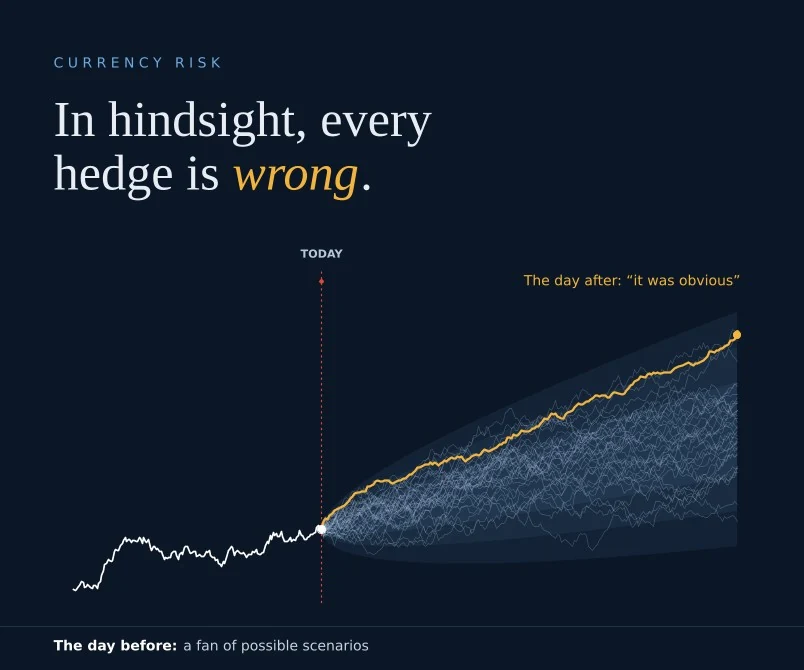
Image content as text
- In hindsight, every hedge is wrong.
- Today: the history up to now, then a fan of possible scenarios. The day before, a hedge is decided against this whole range.
- The day after, only one path remains, and “it was obvious”.
What a defensible hedging decision needs
Hindsight judges a hedge against the one market path that actually happened. A treasury decides before that path is known, against a range of possible outcomes. A fair review therefore asks different questions: was the exposure measured correctly at the time? Did the hedge sit within the ratios the board approved? Was the decision consistent with the information available on that day?
Those questions can only be answered if the information was captured when the decision was taken: the exposure by maturity, the policy band, the market data and the risk figure that justified the hedge. That is also what auditors increasingly look for. Under ISA 570 (Revised 2024) they look more closely at how management assessed risks that can affect going concern, currency risk included.
A structured post-mortem closes the loop. It values matured hedges against the market rate at maturity and measures cash flows against the budget rate, but it reads the result against the policy, not against hindsight. A hedge that cost money because the currency moved favourably is not a mistake if it was within the agreed rules. It is the price of the certainty the company chose.
Extended version of our LinkedIn post of October 2, 2026. Join the discussion on LinkedIn → Website version: extended with AI assistance · reviewed by S. Hamberger

GLORIARMS
GLORIARMS develops GLORIAnalytics, independent FX risk analytics for corporate treasuries and the banks that serve them.
LinkedIn →