
In short
Add up the risks of individual foreign-currency positions and you assume that every currency moves fully against the company at the same time. That rarely happens. The actual risk of a currency portfolio depends on how the currencies move relative to each other: on their correlation. The result is only as good as the correlations that go into it.
The post
Your currency risk is smaller than the sum of its parts. Usually.
An example with three positions: EUR 15m added up one by one, EUR 7m as a portfolio. The difference is correlation.
Add up stand-alone risks and you assume all currencies move against you at the same time. That rarely happens. Here the difference is roughly 53%.
But the 53% is only as good as the correlations you calculate with. And they can change.
That is why we recalculate them in GLORIAnalytics every day.
Does your hedging policy look at positions one by one, or at the portfolio?
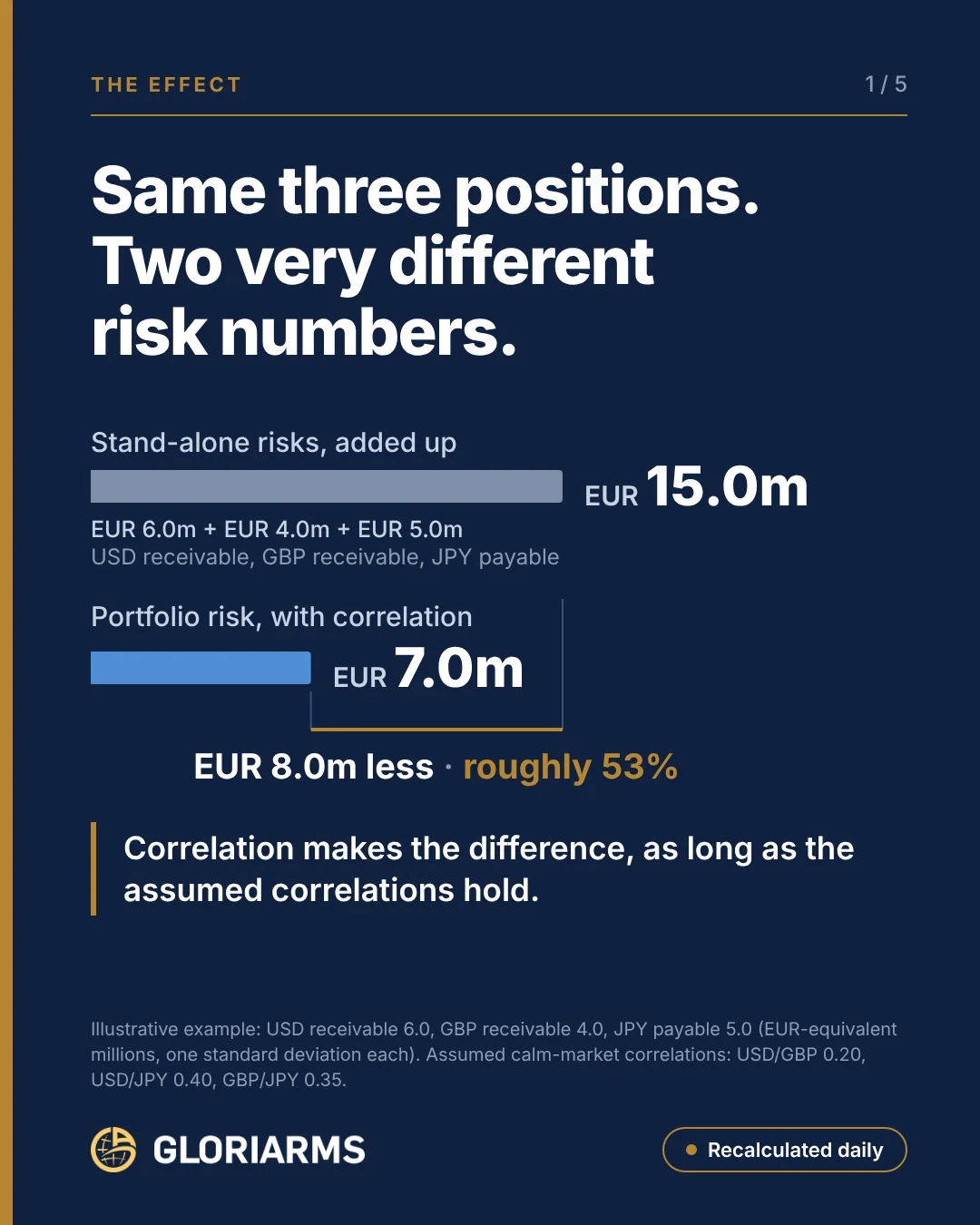
Image content as text
- The effect: same positions, two different risk numbers.
- Stand-alone risks added up: EUR 15.0m (EUR 6.0m + 4.0m + 5.0m; USD receivable, GBP receivable, JPY payable).
- Portfolio risk with correlation: EUR 7.0m, which is EUR 8.0m or roughly 53% less.
- Correlation makes the difference, as long as the assumed correlations hold.
- Illustrative example; assumed correlations in a calm market: USD/GBP 0.20, USD/JPY 0.40, GBP/JPY 0.35.
The example in detail
The portfolio holds a USD receivable, a GBP receivable and a JPY payable. Each risk is stated in euros: the possible change in value over the planning period.
| Position | Stand-alone risk |
|---|---|
| USD receivable | EUR 6.0m |
| GBP receivable | EUR 4.0m |
| JPY payable | EUR 5.0m |
| Sum of stand-alone risks | EUR 15.0m |
| Portfolio risk with correlation | EUR 7.0m |
Two effects explain the gap. The two receivables only partly move together, so their risks do not add up in full. And the JPY payable works the other way: if the yen rises against the euro together with the dollar and the pound, the payable costs more while the receivables are worth more. It acts as a natural hedge.
The sum is therefore an upper bound, reached only if every position moves fully against the company at the same moment. A hedging policy sized on that sum may plan more hedging than needed. In GLORIAnalytics the correlation-based figure is called Correlation Adjusted.
The catch is in the post: the 53% holds only as long as the correlations hold. Part 2 shows what happens in a stress phase.
First published on October 8, 2026 on LinkedIn. Original language: German. Join the discussion on LinkedIn → Website version: adapted from the original with AI assistance · reviewed by S. Hamberger

Stefan Hamberger
More than 30 years in FX and eFX, previously Managing Director at Commerzbank and Crédit Agricole CIB. Helps CFOs and treasurers understand their FX risk before the market moves.
LinkedIn →